
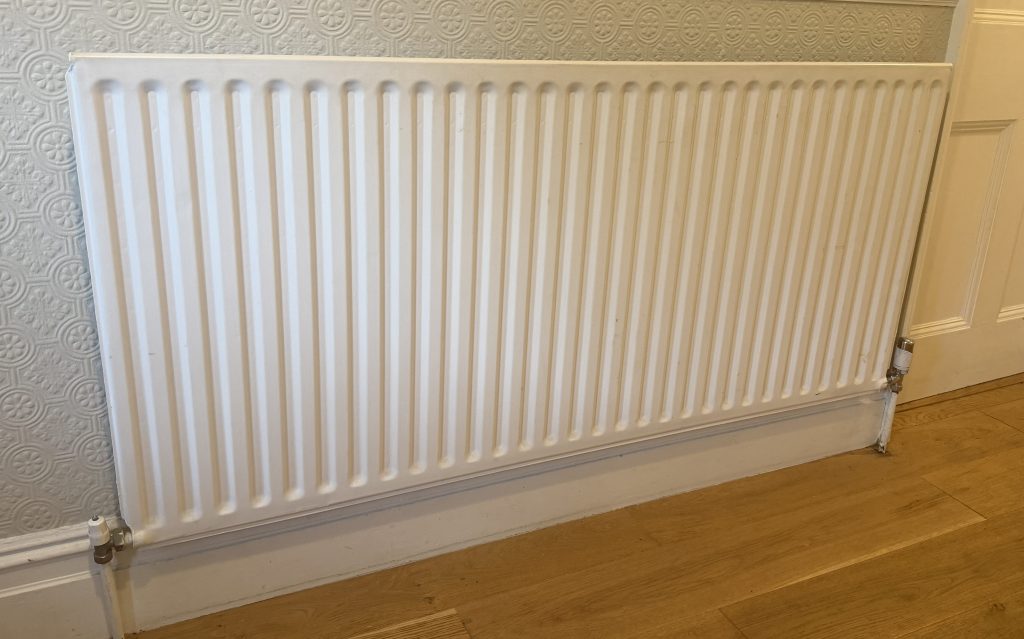
Cold at the top, cold at the bottom, cold all over, gurgling, clicking or too hot to touch: each radiator problem has its own cause, and most of them are things you can check yourself before you call anyone or turn the heating up.
For my latest video I asked my dad, Roger Bisby, who’s a qualified plumber, to talk through the radiator problems he sees most. As he puts it, he never gets those calls in summer; they all come in the week people switch their heating back on. Watch the video to see each fix done, then use this page to find your symptom and jump straight to Roger’s answer.
Radiator Not Heating Up? Cold Spots, Noises & Other Problems Explained, on my YouTube channel. Subscribe to catch the rest of the heating series.
For how radiators work, how to size them and step-by-step bleeding instructions, see my guide Radiators: What you need to know. This page is the troubleshooter.
First: is it actually a fault?
A radiator that’s gone cold isn’t always broken. Before you reach for the radiator key, check these.
What a normal radiator feels like (watch at 01:09). It will usually be a bit hotter at the top, because heat rises, but it should be warm all over. A slight difference is fine; a clearly cold patch isn’t.
Judge the room, not the radiator (watch at 01:45). Roger’s point is that the room temperature is what matters. If your radiator has a thermostatic radiator valve (TRV), it shuts the radiator off once the room is warm enough. So a radiator that goes cold in a warm room is doing exactly what it should.
What the numbers on a TRV mean (watch at 02:03). A TRV senses the room temperature and works like a tap: it closes as the room warms up and opens again as it cools. The setting is the room temperature you want, not how hot the radiator gets. Setting 0 is usually a frost setting, which only lets the radiator come on if the room gets close to freezing, so a radiator left on 0 will feel cold most of the time.
Cold spots: what each one is telling you
Where the radiator is cold is the best clue you’ve got. Run the heating for 20 minutes, then carefully feel across it.
Cold at the top
This is trapped air. Air is lighter than water, so it collects at the top and stops the hot water filling the radiator. The fix is to bleed it with a radiator key:
- Turn the heating off first, so you don’t get scalded.
- Hold a cloth under the bleed valve at the top corner.
- Open the valve slowly, no more than one full turn. You’ll hear a hiss as the air escapes.
- Close it as soon as water appears.
- Check the boiler pressure afterwards, as letting air out can lower it.
Roger demonstrates this from 06:14.
Cold at the bottom
This is sludge: steel from inside the system that has corroded and settled in the bottom of the radiator, blocking the flow. Bleeding won’t help. The system needs flushing, and in bad cases the radiator has to come off the wall and be flushed out outside with a hose. If several radiators are affected, get a heating engineer to clean the whole system and add fresh inhibitor.
Cold all over
If one radiator won’t heat at all, the usual culprit is a TRV pin that has jammed after sitting closed all summer. Unscrew the TRV head and you’ll see a small metal pin. Gently push it down a few times until it moves freely, then refit the head. Roger’s warning: don’t try to pull the pin up with pliers. You can pull it out completely and cause a leak.
Some radiators hot, the furthest ones lukewarm
The radiators nearest the boiler may be taking all the hot water. That’s a balancing job, explained further down this page.
None of the radiators are warming up
If the whole house is cold, look at the boiler before the radiators. Check the pressure gauge first. On most sealed systems, if the pressure drops below about 1 bar (some boilers go down to 0.5 bar), the boiler shuts itself down to protect itself, and the system needs topping up through the filling loop. Your boiler manual shows the right pressure and how to do it. While you’re there, check the thermostat and timer are actually calling for heat, and note any fault code on the display.
Radiator too hot to touch
A scorching radiator is a burn risk, especially with children or older relatives in the house. Roger’s fix is to turn down the boiler’s heating water temperature, to around 50°C. Cooler water also lets a modern condensing boiler work more efficiently, so you save money as well. Rooms will take a little longer to warm up, which is normal.
Radiator noises: what that sound means
Noises are easier to recognise than to describe, so it’s worth hearing them in the video.
| What you hear | Likely cause | What to do |
|---|---|---|
| Gurgling | Air in the radiator | Bleed it, then check the boiler pressure |
| Clicking or ticking as the heating warms up or cools down | Pipes expanding and rubbing against the wooden floor joists | Usually harmless; an engineer can ease pipes where they’re tight |
| High-pitched whistling at a valve | Water squeezing through a valve that’s nearly closed | Open the TRV or lockshield valve slightly |
| Rumbling or a kettle-like noise from the boiler | Limescale or sludge in the boiler (known as kettling) | Call a Gas Safe registered engineer |
The last one isn’t covered in the video, but it’s worth knowing: a boiler that sounds like a kettle is working harder than it should, and anything inside the boiler is a job for a Gas Safe registered engineer.
Balancing your radiators
If the radiators near the boiler get hot quickly and the ones at the far end of the house stay lukewarm, the system needs balancing. Hot water takes the easiest route, so the nearest radiators take more than their share. Balancing means adjusting the lockshield valve on each radiator (the one under the plastic cap, opposite the TRV) so the closer ones are turned down slightly, leaving enough hot water for the radiators at the end of the run. Roger explains how it works in the video.
Other things worth checking
A few more common problems that aren’t in the video:
- Radiators go cold when a hot tap is running. Normal on a combi boiler: it gives hot water priority and the radiators pause until the tap is off.
- Upstairs cold, downstairs fine. Usually low pressure or air in the upper part of the system. Check the pressure, then bleed the upstairs radiators.
- The same radiator needs bleeding every week or two. Air is getting in, or corrosion is producing gas inside the system. Get a heating engineer to find the cause.
- Drips and leaks. A drip from the bleed valve usually means it isn’t fully closed. A weep where a valve meets the pipe can often be stopped by nipping the nut up a fraction, holding the valve steady with a second spanner. Water from the face or seams of the radiator means it has corroded from inside and needs replacing.
When to call a heating engineer
Bleeding, freeing a TRV pin and topping up the pressure are everyday DIY jobs. Call in a professional if:
- every radiator is cold and the thermostat, timer and pressure all check out
- the boiler shows a fault code, keeps losing pressure, or is rumbling or kettling
- several radiators are cold at the bottom and the system needs a flush
- a radiator needs bleeding every week or two
- a radiator is leaking from its body rather than a valve
For any work on the boiler itself, use a Gas Safe registered engineer. You can check an engineer’s registration on the Gas Safe Register website before they start.
Quick answers
Why has my radiator gone cold when the room is warm? The TRV has done its job and shut the radiator off. It will come back on when the room cools. (01:45)
Why is my radiator cold at the top? Trapped air. Turn the heating off, bleed it, then check the boiler pressure. (04:13)
Why is my radiator cold at the bottom? Sludge has settled inside. It needs flushing, not bleeding. (07:40)
Why is one radiator not heating up at all? Most often a TRV pin stuck after the summer. Take the head off and gently push the pin down until it moves freely. (09:14)
Why are none of my radiators working? Check the boiler pressure. Below about 1 bar, many boilers shut down until the system is topped up. (12:30)
Why is my radiator gurgling? Air in the system. Bleeding usually stops it. (16:51)
Why do my radiator pipes click? They expand as they warm and rub on the floor joists. It’s usually harmless. (16:51)
See it for yourself
It’s one thing reading that a radiator is “cold at the bottom” or “gurgling”, and another to see and hear it. Watch the full video on YouTube to see each problem explained, and subscribe to the channel for the rest of the heating series.
For a seasonal checklist of what to do around the home each month, sign up to the Your Home Explained newsletter.