
Most radiator problems have a simple cause, and most of the fixes need nothing more than a radiator key, a towel and twenty minutes. This guide goes alongside my video on radiators: watch that for the hands-on demo, and use this page as the reference to come back to when the heating goes on each autumn.
Radiator not heating up or making odd noises? My troubleshooting guide, Radiator Not Heating Up? Cold Spots, Noises and Other Problems Explained, goes symptom by symptom with plumber Roger Bisby’s fixes and links straight to each answer in the video.
We’ll cover how radiators actually heat a room, how to tell whether yours are big enough, bleeding and balancing, what different cold spots are telling you, and when it’s time to call in a heating engineer.
How a radiator actually heats your room
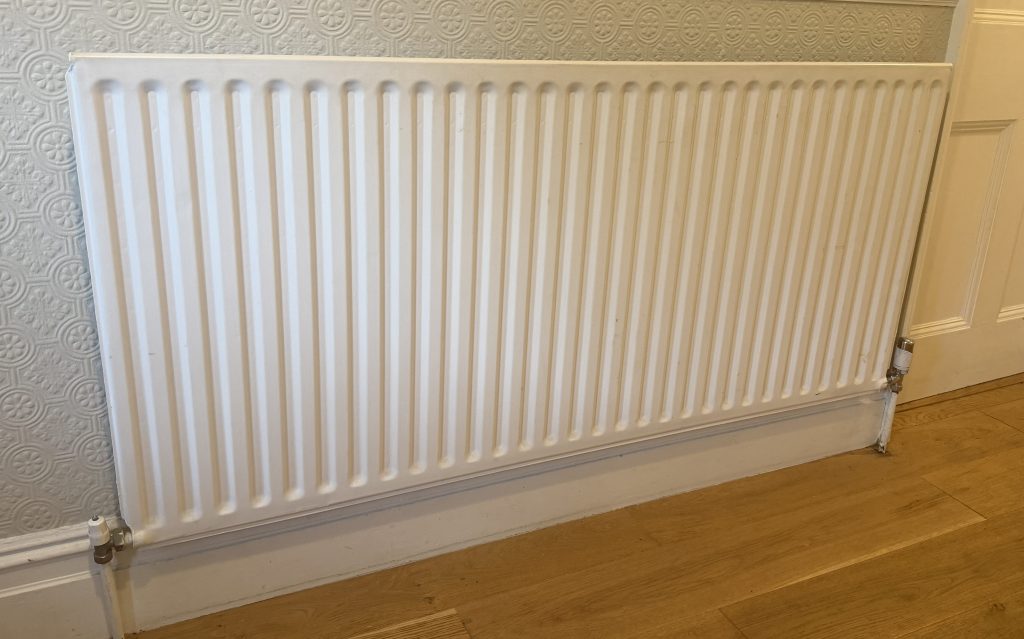
Despite the name, a radiator does most of its work by convection, not radiation. Hot water from the boiler warms the metal, the metal warms the air touching it, and that warm air rises and circulates around the room. Only a minority of the heat is radiated directly at you.
That’s why the fins in the middle of a modern radiator matter, and why anything that blocks the air flow – a sofa pushed hard against it, long curtains tucked behind it – cuts its output.
In a typical UK “wet” system, the boiler pumps hot water out along the flow pipe, through each radiator, and back along the return pipe. Each radiator has two valves: one you turn (a manual wheel-head or a thermostatic radiator valve, TRV) and a lockshield valve on the other end, usually hidden under a plastic cap, which sets how much water that radiator gets.
Radiator types at a glance
Steel panel radiators are described by a type number: how many panels they have and how many sets of fins.
| Type | Build | Typical use |
|---|---|---|
| Type 11 (K1) | One panel, one set of fins | Small rooms, bathrooms, hallways |
| Type 21 (P+) | Two panels, one set of fins | Bedrooms, a step up in output without extra depth |
| Type 22 (K2) | Two panels, two sets of fins | The UK workhorse: living rooms, bigger bedrooms |
| Type 33 (K3) | Three panels, three sets of fins | Large or draughty rooms, heat pump systems |
More panels and fins means more output from the same width and height, at the cost of a deeper radiator that sits further off the wall.
Is your radiator big enough?
A room that never gets properly warm, even when every radiator is hot top to bottom, may simply have a radiator that’s too small for it. Output is measured in watts or BTUs (1 watt is about 3.4 BTU/h), and the right figure depends on the room’s size, how well it’s insulated, how many outside walls and windows it has, and what it’s used for.
Online radiator calculators give a reasonable starting point. For a whole-house picture, a heating engineer can do a room-by-room heat loss calculation, which is the only way to size radiators properly.
The small print on the box: Delta T
The output printed on a radiator is almost always quoted at “Delta T 50” (ΔT50). That’s the difference between the average water temperature in the radiator and the room, and it assumes water at around 70°C in a 20°C room.
Plenty of homes now run cooler than that – and for good reason, as we’ll see under flow temperature. Run the same radiator with cooler water and it gives out noticeably less heat:
- A boiler turned down to a 60°C flow: roughly two-thirds of the box figure
- A heat pump running at 40–45°C: roughly a third to a half of the box figure
This is why heat pump installations often include some larger radiators. It isn’t that heat pumps are weak; it’s that cooler water needs more radiator surface to deliver the same warmth. If you’re comparing radiators, check that the outputs are quoted at the same Delta T.
How to bleed a radiator
If a radiator is warm at the bottom but cold at the top, there’s air trapped in it. Bleeding lets that air out. It’s the single most common radiator job and takes a few minutes per radiator.
You’ll need: a radiator key (a few pounds from any DIY shop; some modern bleed valves take a flat screwdriver instead), an old towel or cloth, and a small container.
- Turn the heating off and let the radiators cool. Hot water can spurt out, and with the pump running you may draw more air in.
- Find the bleed valve. It’s a small square-centred valve at one of the top corners of the radiator.
- Protect the floor and wall. Hold the cloth under the valve and the container beneath it.
- Open the valve slowly – about a quarter of a turn anticlockwise is plenty. You should hear a hiss as the air escapes.
- Close it as soon as water appears. A steady dribble of water with no spitting means the air is out. Don’t open it fully; the pin can come out.
- Repeat on any other cold-topped radiators. If you have a two-storey house, start downstairs and work up.
- Check the boiler pressure. Letting air out lowers the pressure in a sealed system. Most combi and system boilers like to sit at roughly 1–1.5 bar when the system is cold; check your boiler manual for its figure. If it’s dropped below that, top it up using the filling loop (again, the manual shows how).
- Turn the heating back on and check the radiators heat evenly.
If you’re bleeding the same radiator every week or two, something is letting air into the system or producing gas inside it – often corrosion. That’s worth a heating engineer’s visit rather than more bleeding.
What your cold spots are telling you
Where a radiator is cold tells you most of what’s wrong. Run the heating for 20 minutes, then carefully feel across the radiator.
| What you notice | Likely cause | What to do |
|---|---|---|
| Cold at the top, warm at the bottom | Trapped air | Bleed the radiator |
| Cold at the bottom or in the middle, warm at the top | Sludge (rust and debris) settled inside | A flush, either of that radiator or the whole system |
| One radiator cold all over | A stuck TRV pin, a closed lockshield, or poor balancing | Check the valves (see below), then balance |
| Radiators furthest from the boiler lukewarm | System out of balance | Balance the radiators |
| Upstairs radiators cold, downstairs fine | Low system pressure or air in the upper circuit | Check the boiler pressure, bleed upstairs |
| Every radiator cold | Boiler, pump, pressure or controls fault | Check the pressure and the thermostat and timer settings; if those are fine, call an engineer |
| Constant need for bleeding | Air getting in or corrosion producing gas | Call a heating engineer |
The stuck TRV pin. TRVs that have sat closed all summer often seize. Take the TRV head off (most unscrew or unclip) and you’ll see a small metal pin. It should move in and out freely when pressed. If it’s stuck down, a few gentle taps or a wiggle with pliers usually frees it. Then refit the head.
Getting the heat into the room
Because radiators work mainly by moving warm air, the space around them matters as much as the radiator itself.
- Keep furniture clear. A sofa against a radiator absorbs the heat and blocks the air flow. Even a gap of 15–20cm helps.
- Tuck curtains behind the windowsill, not the radiator. Full-length curtains drawn over a radiator under a window send its heat up behind the curtain and out through the glass.
- Radiator reflector panels – foil-faced sheets fitted behind the radiator – are cheap and make the most difference on outside walls that aren’t insulated, such as solid brick walls in older homes. On an insulated or internal wall the benefit is small.
- Radiator covers and boxed-in radiators look neat but trap heat. If you want one, choose a design with an open grille front and top.
- Drying clothes on radiators blocks the output and puts a lot of moisture into the room, which can feed condensation and mould. A clothes airer near, not on, the radiator is the better option, with a window ajar or an extractor running.
- Dust the fins. A long radiator brush or a vacuum crevice tool clears the dust that builds up between panels.
Radiator questions, answered
Why is my radiator cold at the top? Air is trapped in it. Turn the heating off, let it cool and bleed it with a radiator key, then check the boiler pressure.
Why is my radiator cold at the bottom? Usually sludge has settled inside. The radiator or the whole system needs flushing, and the water needs fresh inhibitor.
Does turning a TRV up to 5 heat the room faster? No. A TRV sets the temperature the room reaches before the radiator shuts off, not how quickly it gets there.
What pressure should my boiler be? Most sealed systems sit at around 1–1.5 bar when cold, rising a little when hot. Your boiler manual gives the exact figure.
Should I turn down my boiler’s flow temperature? On a condensing combi boiler, usually yes. Nesta estimates that turning it down from 80°C to around 60°C saves about 9% on your gas bill, and plumber Roger Bisby suggests going as low as around 50°C if your rooms still get warm enough. There’s more on this in my radiator troubleshooting guide.
How often should I bleed my radiators? Only when they need it – typically when you first turn the heating on in autumn, or if a radiator is cold at the top.
Are radiator reflector panels worth it? On uninsulated outside walls, yes, they’re cheap and help. On insulated or internal walls, the gain is small.
Sources
- Thermostatic radiator valves – householder factsheet, BEAMA
- Part L 2022 heating controls guidance, BEAMA
- Part L Building Regulations: what you need to know, Danfoss
- Money Saving Boiler Challenge campaign, Nesta
- Boiler Upgrade Scheme, Energy Saving Trust
- Boiler Upgrade Scheme grant values from 21 July 2026, GOV.UK