
Baking soda might be the most repeated cleaning hack there is; sprinkle it on almost anything and someone online will tell you it works. But sodium bicarbonate is a specific chemical with a specific job, and it’s worth being clear about what that job actually is before you build your whole cleaning cupboard around it. Here’s what the chemistry actually says it’s good for, what it isn’t, and where my own testing backed that up.

What baking soda actually is, chemically
Sodium bicarbonate is a mild alkali, sitting at around pH 9 — noticeably less caustic than something like oven cleaner or drain unblocker, but enough to react with acids. That single property explains almost everything it’s good and bad at. It also has a fine, gritty crystal structure, which gives it a gentle mechanical scrubbing action separate from any chemical reaction.
Where it genuinely earns its reputation
Most household odours, in fridges, bins, carpets, trainers, come from acidic compounds. Because baking soda is alkaline, it neutralises those acids on contact rather than just masking them with fragrance, which is the actual chemistry behind decades of “put a box in your fridge” advice.
That same mild alkalinity, combined with the gentle abrasion from its texture, also makes it genuinely useful for everyday grime — worktops, hobs, mugs — where the mess is light and fresh rather than baked in. It’s also cheap, non-toxic, and won’t damage most surfaces the way stronger chemical cleaners can, which is a real advantage for routine cleaning even where it isn’t the most powerful option available.
Where the chemistry runs out: limescale
Limescale is calcium carbonate, an insoluble alkaline salt left behind when hard water breaks down. Dissolving it requires an acid — something like citric or lactic acid — which reacts with the calcium carbonate to form soluble compounds that rinse away. Baking soda is alkaline, not acidic, so chemically it’s working against itself here: it can’t do the one thing limescale removal actually requires. It’s a mismatch of chemistry, not a matter of scrubbing harder. I tried it on my own limescale-covered taps and got nowhere — swapping to a proper acidic descaler cleared it up in minutes.
Where the chemistry runs out: baked-on grease
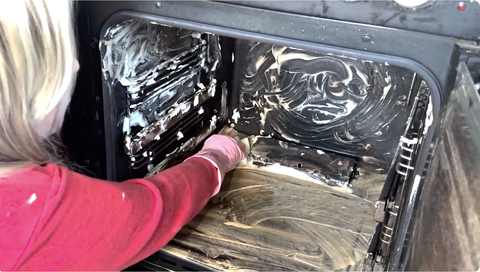
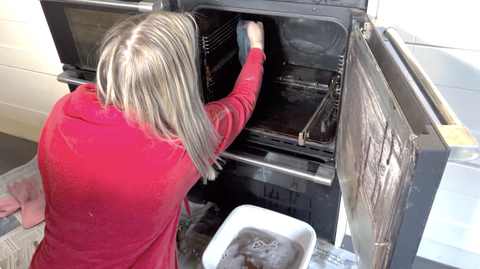
This is the one I tested myself, on a family oven, and it didn’t clean it, and the chemistry explains why. Genuinely dissolving fat requires saponification, a reaction strong alkalis like sodium hydroxide (the active ingredient in proper oven cleaner) can drive, but baking soda’s mild pH simply isn’t strong enough to do that to grease that’s been baked on and carbonised over repeated use. What cleaning action baking soda does provide against grease is mostly physical abrasion, useful on light, fresh grease, but no match for grime that’s had months to set hard.
There’s also a practical issue worth knowing regardless of how tough the grime is; baking soda’s mild abrasiveness “could damage the coating” on non-stick cookware or air fryer baskets, so it’s worth keeping off anything with a non-stick finish altogether.
Where the chemistry runs out: blocked drains
Baking soda can genuinely neutralise the smell coming from a sink, because that’s an acid-base reaction it’s well suited to. But a blockage is a physical mass of hair, fat or debris, not a pH problem, neutralising the odour around it does nothing to shift what’s actually stuck in the pipe. Worth noting too: mixing baking soda with vinegar for this job is popular but chemically self-defeating. The fizzing reaction produces mostly carbon dioxide and salty water, the two ingredients’ individual cleaning power is “cancelled out” the moment they react with each other, so you lose the strengths of both rather than combining them.
The bottom line
Baking soda is a genuinely useful, cheap, low-toxicity product for the jobs its chemistry actually suits: neutralising odours and lifting light, fresh grime. For limescale, baked-on oven grease, or anything that’s actually blocking a pipe, it’s the wrong tool for the job, and no amount of scrubbing changes the chemistry.
Quick answers
Does baking soda remove limescale?
No. Limescale is calcium carbonate, which needs an acid (like citric or lactic acid) to dissolve. Baking soda is alkaline, so it can’t break it down.
Can baking soda clean a really dirty oven?
Not on its own, for baked-on grime. It lacks the strength to fully break down carbonised grease and mostly works by light abrasion which is fine for fresh spills, not for months of build-up.
Does baking soda unblock a drain?
No. It can neutralise the smell from a blockage, but a clog is a physical mass, not an odour problem, so it won’t shift what’s actually stuck.
What is baking soda actually good for when cleaning?
Neutralising odours (fridges, bins, carpets) and light, fresh everyday grime, thanks to its mild alkalinity and gentle abrasive texture.