
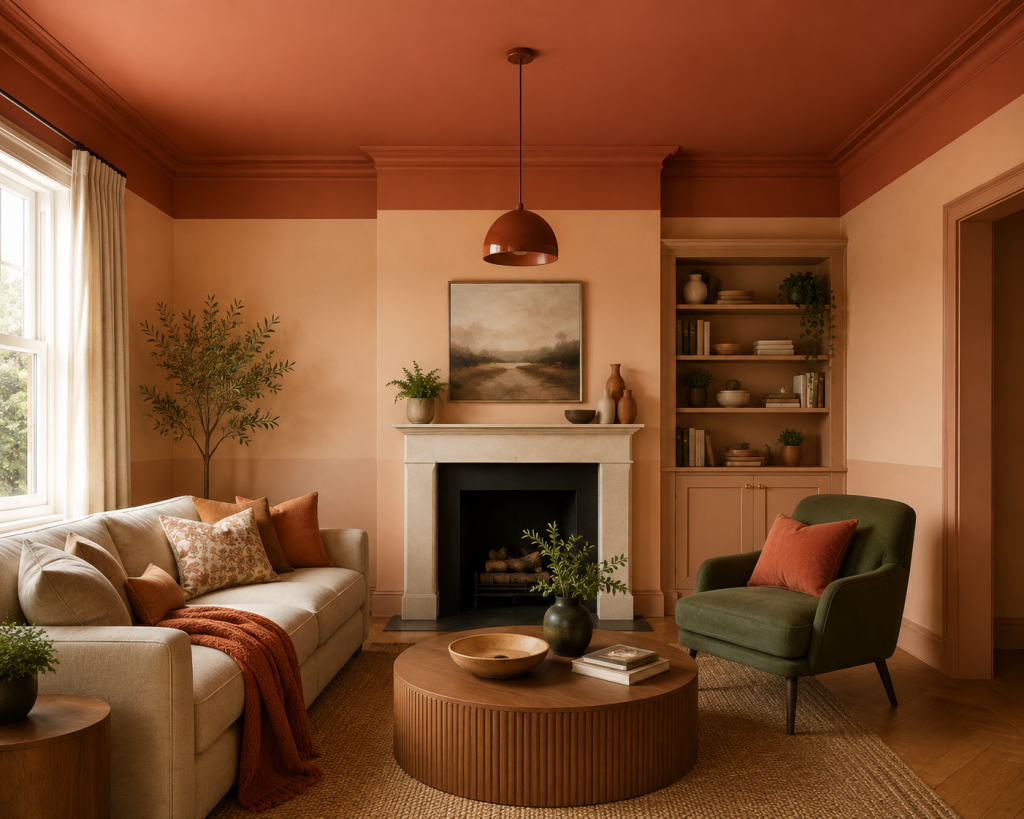
If you’ve scrolled through social media or flicked through interior design magazines recently, you’ve likely seen colour capping taking over living rooms across the UK.
Moving past “colour drenching” (painting an entire room—skirting, walls, and ceiling—in one flat shade) and “double drenching” (using contrasting saturated colours across all surfaces), colour capping offers a far more refined, architectural approach. It involves taking 2 to 3 shades from a single colour family and layering them so the tone deepens as it travels up the wall, culminating in a rich, saturated treatment on the “fifth wall”—your ceiling.
While design experts praise colour capping for drawing the eye upward and creating a cosy, high-end cocooning effect, there is an underlying building science story that isn’t being talked about. When executed thoughtfully, colour capping interacts directly with room physics, Light Reflectance Value (LRV), and human thermal perception—helping you save energy on both heating and lighting.
Here is the straightforward breakdown of how the trend works, the science behind why it impacts your energy bills, and how to execute it safely in your home.
What is colour capping?
Colour capping uses a single colour family to create a soft, gradient-like transition from the floor up to the ceiling:
- Lower Walls / Main Walls: A gentle, low-saturation base shade (e.g., a soft stone, pale sage, or muted biscuit).
- Cornices, Picture Rails & Upper Trim: A mid-tone shade from the exact same color swatch.
- Ceiling & Capping Band: The deepest, most saturated tone in the palette (e.g., deep terracotta, rich olive, or warm rust).
Unlike traditional decorating—which defaults to bright brilliant white ceilings above coloured walls—colour capping intentionally integrates the ceiling into the room’s overall environmental design.
| Paint Trend | Wall Treatment | Ceiling Treatment | Visual Effect |
| Traditional | Mid-tone Colour | Brilliant White Paint | High contrast, hard horizontal break |
| Colour Drenching | Single Shade Throughout | Same Single Shade | Monolithic, dramatic, dark |
| Double Drenching | Saturated Colour A | Saturated Colour B | High energy, high contrast |
| Colour Capping | Light/Mid-tone Base | Saturated Tone from Same Palette | Soft gradient, architecturally heightening, cocooning |
The building science: How paint choices impact energy bills
Decorating isn’t just cosmetic. Every tin of paint you apply alters how light reflects inside your living space and how warm or cold you feel sitting in it.
1. Understanding Light Reflectance Value (LRV)
Every paint colour has a Light Reflectance Value (LRV) rating printed on the back of the swatch or listed in the technical data sheet. LRV is measured on a scale from 0% (absolute black, absorbing all light) to 100% (pure white, reflecting all light).
- The Common Mistake: Homeowners often assume painting ceilings dark (low LRV) requires turning on high-wattage task lights to compensate.
- The Colour Capping Solution: Because colour capping keeps the main mid-level walls in a higher LRV range (typically 50% to 70%), natural light entering through windows continues to bounce off the wall surfaces at eye level. By using a satiny or eggshell finish overhead rather than a dead-matt paint, the deep ceiling shade reflects ambient light horizontally across the room rather than absorbing it completely. You maintain a bright workspace without adding extra lamp load.
2. Thermal perception: The psychological thermostat
The relationship between interior wall colours and perceived temperature is a well-documented phenomenon in environmental psychology.
Research into human thermal comfort consistently shows that room environments styled in warm undertones—such as rich terracottas, warm clays, ochres, and muted buff shades—can alter human temperature perception.
When a room feels psychologically warmer due to its visual spectrum, occupants are significantly less inclined to nudge the central heating thermostat up. According to Energy Saving Trust data, turning your room thermostat down by just 1 degrees can cut your annual heating bill by up to 10%.
3. Circadian health and evening lighting power
Brilliant white ceilings combined with cool-white LED bulbs create harsh contrast glare that delays nighttime melatonin release.
Colour capping creates a natural visual anchor overhead. When paired with warm-white LED lighting (2,700 Kelvin or lower), the deeper ceiling shade absorbs high-frequency blue wavelengths. This produces a soft, ambient glow that mimics natural sunset tones, relaxing your eyes in the evening while allowing you to turn off harsh overhead ceiling lights in favour of low-wattage accent lamps.
Healthy home warning: Check your paints before you paint upwards
When applying saturated paint to ceilings and upper wall bands, indoor air quality (IAQ) requires careful attention:
- Watch Out for VOC Off-Gassing: Volatile Organic Compounds (VOCs) are solvents used in paints that evaporate into indoor air as the paint cures. Because warm air naturally rises toward the ceiling, high-VOC paint applied to ceilings off-gasses more rapidly when central heating runs. Always specify Ultra-Low VOC or Zero-VOC water-based paints for capping projects.
- Beware Moisture Traps: Avoid using non-breathable, heavy oil-based gloss finishes on ceilings in older or solid-wall properties (such as Victorian terraces). Traditional homes need vapor-permeable paint (such as mineral, clay, or chalk-based paints) to prevent moisture from getting trapped above the plaster, which can lead to blistering paint or unseen ceiling dampness.
How to get the look safely: Step-by-step
If you’re ready to try colour capping in a living room, dining space, or bedroom:
- Pick one colour family: Choose three shades from a single paint fan deck. For example:
- Base Wall: Gentle Peach/Sand
- Cornice/Trim: Muted Apricot
- Ceiling Cap: Deep Terracotta
- Mark your lines accurately: Use a laser level or spirit level rather than trusting standard ceiling joints, which are rarely straight in UK homes.
- Finish strategy: Use a durable Matt finish on the main walls for easy cleaning, and an Eggshell or Low-Sheen Satin on the ceiling cap to allow subtle ambient light bouncing.