
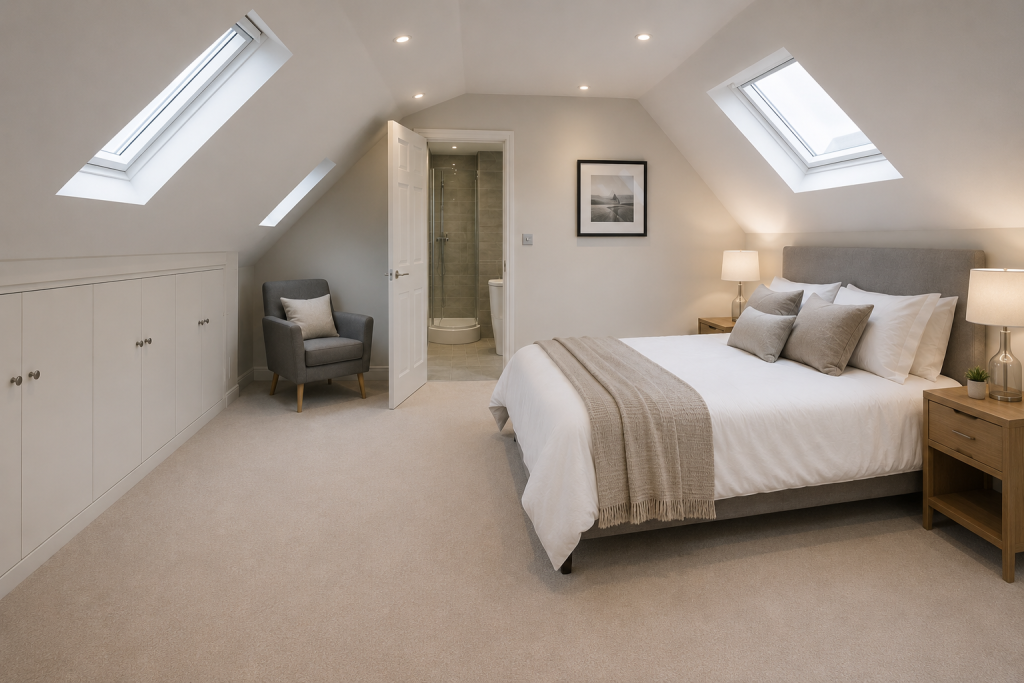
If you live in a UK home with a loft conversion, you already know the summer routine. While the downstairs kitchen might feel quite pleasant, stepping up into the loft bedroom feels like walking directly into a greenhouse.
In our previous post on using a thermometer and hygrometer around the home, we talked about how different rooms have completely different microclimates. And during a UK heatwave, no room behaves more aggressively than the loft.
Because most British homes aren’t fitted with retrofitted air conditioning, sleeping in a converted attic during July or August can feel near-impossible. But before you shell out hundreds on a noisy, energy-guzzling portable AC unit, it helps to understand why your loft is so hot, and the physics-backed tricks you can use to cool it down.
Why do UK loft conversions trap heat so badly?
It isn’t just your imagination; attic rooms genuinely get much hotter than the rest of the house, and it boils down to two main architectural flaws.
1. The “Greenhouse Effect” from roof radiation
In a standard room, you have a ceiling, a loft cavity full of insulation, and then a roof acting as a buffer against the sun. In an attic conversion, that buffer is gone. Your ceiling is the pitch of the roof. Even with modern building regulations and insulation, dark roof tiles absorb relentless solar radiation all day and radiate that thermal energy directly downward into your living space.
2. Convection (hot air rises)
Basic physics dictates that warm air expands and rises. Every bit of heat generated by cooking, electronics, and human bodies downstairs naturally travels up your stairwell. Your loft conversion essentially acts as a giant chimney cap, trapping all the rising heat from the floors below with nowhere else for it to go.
4 Practical ways to cool your loft bedroom
To beat the heat, you have to tackle both the heat trying to get in through the roof, and the heat trying to rise from below. Here is how to do it without an AC unit.
1. Stop the sun before it hits the glass
Standard indoor blinds are largely useless against intense summer heat. By the time sunlight passes through your Velux or dormer windows and hits an internal fabric blind, the heat is already inside the room.
- The Fix: Invest in external awning blinds or shutter screens. These fit on the outside of your roof windows, blocking up to 70% or more of the sun’s energy before it ever touches the glass.
- The Budget Alternative: If external blinds aren’t an option, look for internal radiant barrier blinds or reflective blackout blinds with a silverised coating facing the window to bounce the light back out.
2. Master the “box fan outward” trick
Most people walk into a hot bedroom, point a desk fan directly at their face, and turn it on max. All this does is move hot air across your skin. To actually lower the room’s temperature, you need to use the fan to manipulate air pressure.
The Outward Fan Hack: When the evening air outside finally drops below your indoor temperature (check your thermometer!), open your loft window and place a box fan on the sill facing outward.
By blowing the hot air out of the room, you create a localised low-pressure zone. This forces the cooler evening air from the outside to be sucked into the room through any other open windows, dramatically speeding up the cooling process.
3. Create a passive “chimney effect” cross-ventilation
Remember how heat rises up your stairs? You can use this to your advantage to create a natural breeze without using any electricity at all.
- Open a window on the lowest floor of your house (e.g., the ground floor kitchen or living room) on the shaded side of the building.
- Open your highest loft window on the opposite side of the house.
- The cool air from downstairs will be drawn up through the house, pushing the trapped hot air out of the top of the attic window like a chimney.
(Note: Keep the doors to intermediate rooms closed so the air is forced straight up the stairwell).
4. Close the hatch during the day
If you have a door or a closing hatch at the bottom of your loft stairs, keep it shut between 11 AM and 4 PM.
While it’s tempting to leave it open to “air it out,” you are actually just allowing the rising ambient heat from the rest of the house to climb straight up into your bedroom during the hottest parts of the day. Isolate the loft until the outdoor temperature begins to drop in the evening.
Summary: Your heatwave checklist
| Strategy | Action | Why it works |
| Deflect | Use external or reflective blinds | Blocks solar radiation before it enters |
| Isolate | Keep the loft door shut during midday | Prevents downstairs heat from rising up |
| Flush | Point a fan out the window at night | Expels hot air and pulls in cool air |
| Circulate | Open a downstairs and upstairs window | Creates a natural, cooling “chimney” breeze |
By understanding how heat moves through your property, you can drastically improve how comfortable your loft bedroom feels tonight. Put away the expensive AC brochures, try tweaking your airflow habits first, and let your thermometer prove the difference.
Read next: Why a Hygrometer and Thermometer might be the most useful home monitoring tool you’re not using