
8 Oct 2026 · @Georgina
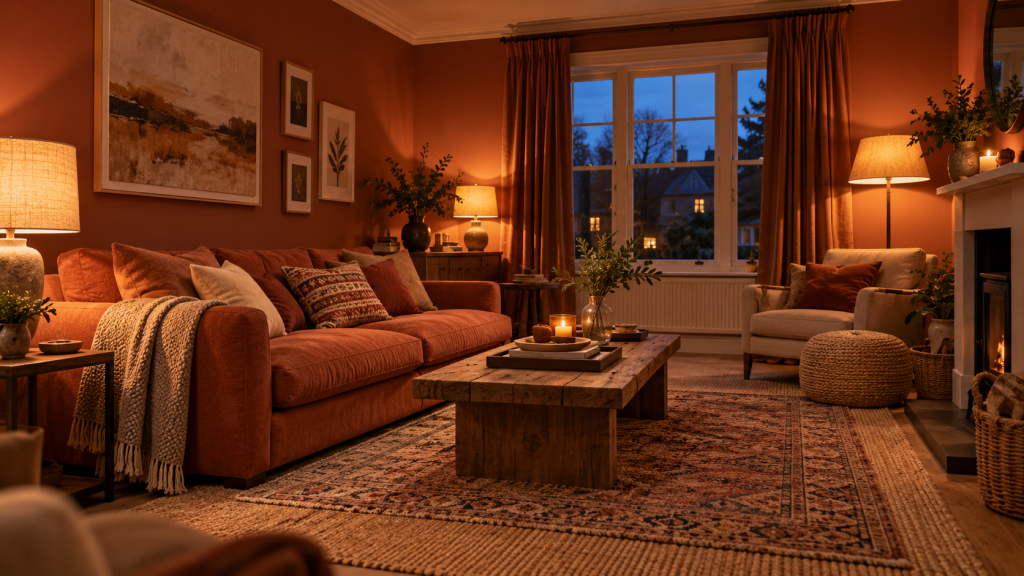
Walk into a room lit by a single cold ceiling light and it can feel chilly before you’ve even checked the thermostat. Walk into the same room glowing with lamplight, a throw on the sofa and a rust-coloured cushion or two, and it feels like somewhere you want to stay.
That’s not just in your head, or rather, it is in your head, and that’s the point. How warm we feel isn’t only about the air temperature. It’s also shaped by what we see and touch around us.
None of this replaces heating, insulation or a good jumper. But as the evenings draw in and energy bills stay front of mind, it’s worth knowing how light, colour and texture can make your home feel cosier, and what the research actually says about whether you can ‘think yourself warm’.
What the research says
Scientists have a name for the idea that colour affects how warm we feel: the hue-heat hypothesis. It suggests that light and colours from the red and orange end of the spectrum make us feel warmer, while blues make us feel cooler. Researchers are interested because, if it works, people might be comfortable with the thermostat turned down a little.
Some studies back it up. Researchers at UCL found people reported higher thermal comfort under warm 2700K light than under cold 6500K light. A team at EPFL in Switzerland found orange-tinted daylight made people feel warmer and blue-tinted light cooler. A virtual-reality study found red walls felt more comfortable in a cold room, and blue walls in a warm one.
But the evidence isn’t settled. A large 2026 study across eight test rooms worldwide found no statistically significant effect of white-light colour temperature on how warm people felt, the actual temperature mattered far more. Another office study testing red, white and blue walls also found no significant effect on comfort.
So the honest answer is: warm light and colour won’t heat your home, and the effect on how warm you feel is probably modest. What they reliably do is make a room look and feel more inviting, and perhaps a room that feels cosy is one you’re more likely to relax in, rather than reaching straight for the thermostat.
Get the lighting right
Lighting is the quickest, cheapest change you can make, and it’s where most homes go wrong in winter.
Check the colour temperature on your bulbs. It’s measured in kelvin (K) and printed on the box. The lower the number, the warmer and more golden the light:
| Colour temperature | How it looks | Best for |
|---|---|---|
| 2200K–2700K | Warm white, candle-like glow | Living rooms, bedrooms, evenings |
| 3000K | Soft white | Kitchens, dining areas |
| 4000K | Cool white | Utility rooms, garages, workspaces |
| 5000K–6500K | Daylight, bluish | Task lighting, craft areas |
If your living room has ‘daylight’ bulbs in it, swapping to 2700K or below is one of the easiest ways to make it feel cosier.
Layer your light. One bright overhead light flattens a room and makes it feel bigger and colder. Instead, use several lower light sources at different heights — a table lamp, a floor lamp, a reading light, LED strips under shelves. Pools of light with softer shadows in between feel more enclosed and snug.
Keep light low. Lamps at or below eye level feel more intimate than ceiling lights. In the evening, try leaving the main light off altogether.
Use dimmers and smart bulbs. A dimmer lets you lower the light as the evening goes on. Tunable smart bulbs let you shift from cooler light during the day to a warm glow at night.
Think about candles and firelight — safely. Real flame is the original warm light, but never leave candles unattended. LED candles and fairy lights give a similar flicker without the risk.
Bring in warm colours
We instinctively link reds, oranges and yellows with fire and sunshine, and blues and greens with water and shade. You can use that to your advantage.
Start small. You don’t need to repaint. Cushions, throws, rugs and curtains in terracotta, rust, mustard, burnt orange or deep red will shift the feel of a room for the winter months — and can be swapped out again in spring.
Warm up your neutrals. If you love pale walls, choose whites and greiges with a yellow, pink or red undertone rather than a blue or grey one. Brilliant white under cool light can make a room feel stark in winter.
Go darker in small rooms. Deep, warm shades such as plum, oxblood, chocolate or forest green with warm undertones can make a snug, TV room or bedroom feel cocooning, especially in rooms you mostly use in the evening.
Remember light and colour work together. Paint looks different under different bulbs. Cool light can make warm colours look muddy, and warm light can make cool blues look grey. Test paint samples under the bulbs you actually use, at the time of day you use the room.
Add warm materials. Natural wood, copper, brass and leather all read as ‘warm’ to the eye. Even a wooden tray, a copper lamp base or a stack of books adds to the effect.
Make it feel warm to the touch
What you touch matters as much as what you see. Hard, cold surfaces draw heat from your skin, which is why a tiled floor feels colder than a carpet at the same temperature.
- Cover hard floors with rugs, especially where you sit or stand barefoot.
- Layer soft textures — wool, sheepskin, bouclé, velvet, chunky knits — on sofas, beds and chairs.
- Keep a throw within reach of every seat, so you grab that before the thermostat.
- Swap to winter bedding such as brushed cotton or flannel sheets.
Don’t forget the real warmth
The cosiest-looking room still feels cold if heat is escaping. Pair the visual tricks with a few practical ones:
- Draw curtains at dusk to keep heat in, and open them on sunny days to let free warmth in.
- Block draughts around doors, windows, letterboxes and keyholes.
- Keep radiators clear of furniture and long curtains so heat can circulate.
- Heat the person, not just the room — warm layers, slippers, a hot drink or a hot-water bottle go a long way.
If you do turn the heating down, take care. People who are older, unwell or have young children should keep their home at a safe temperature — cosy lighting is not a substitute for adequate heating.
Your quick cosy checklist
- Swap living room and bedroom bulbs to 2700K or lower
- Turn off the big light in the evening and use lamps instead
- Add a dimmer or smart bulb where you relax
- Bring in warm-coloured cushions, throws or a rug
- Test paint colours under your own bulbs before you commit
- Cover cold floors and keep throws within reach
- Close curtains at dusk and block draughts
You can’t truly think yourself warm, the science on that is mixed. But you can make your home a place that feels warm, welcoming and restful through the colder months. And for very little cost, that’s well worth doing.
Sources
- Huebner et al., UCL (2014): Saving energy through changing light
- EPFL LIPID: Temperature–colour interaction studies
- Evaluating thermal perception of different wall colors using virtual reality
- Building and Environment (2026): Beyond hue and heat: a multi-site study
- Latini et al.: The role of walls colour in workplace comfort